
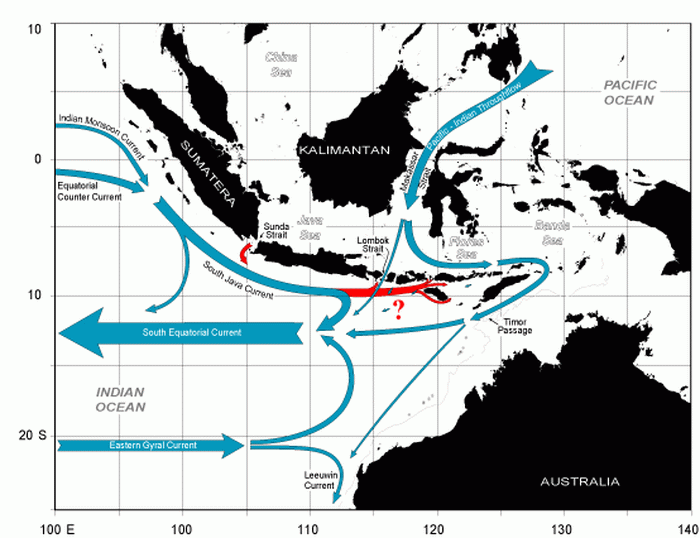
The key to understanding why the diving in Bali is so good. And also why it is also potentially challenging are Sverdrups and the Indonesian Throughflow.
Excellent descriptions of both can be found in David Pickell’s book Diving Bali and also on Wikipedia, But the basic mechanism is the difference in sea-level between the Pacific Ocean to the north-east of the archipelago and the Indian Ocean to the south-west.
This massive disparity is caused by the trade winds and associated oceanic currents. Which act in opposite directions in the northern and southern hemispheres. But the overall result is the largest movement of water on the planet which flows through the Indonesian archipelago.
The 17,000+ islands of the archipelago act as a hydraulic brake on the Indonesian Throughflow. And it is said that if Indonesia did not exist, there would only be 23 hours in each day. Because that hydraulic brake effectively slows down the rotation of the Earth!
So huge is the volume of water associated with the Indonesian Throughflow that traditional measurements are inadequate. Cubic meters and gallons are simply too small to describe it in an easily understandable way. So the Norwegian scientist Harald Sverdrup invented the Sverdrup – one million cubic meters of water per second.
David Pickell visualizes it best in Diving Bali. Think of a river 100m wide, 10m deep and flowing at 2 knots. Then imagine 1,000 of those rivers all combined together – that is one Sverdrup!
It is estimated that the total amount of seawater that passes through the Indonesian Throughflow is 15 Sverdrups. Or 15,000 of those rivers… A massive volume of water which has to make its way through the the Lesser Sundas. The chain of islands that runs along the bottom part of the Indonesian archipelago.
Indonesia’s amazing underwater biodiversity can start to be understood when the contents of the Throughflow are considered. Carried along in the huge volume of water are the eggs and larvae of the Indo-Pacific region marine life. An incredibly diverse area with over 4000 identified species (compared to around 1000 in the Red Sea and 400 in the Caribbean).
As the Throughflow touches land in the north-east of the archipelago around Raja Ampat in Irian Jaya, Halmahera and North Sulawesi it brings with it those eggs and larvae. Along with the rich detritus of the sea, swept up from the deep offshore basins by upwellings created by the huge volume of water flow.
Virtually everything that dies is the sea descends to the bottom, where it decomposes. Creating a rich layer of phosphorous and nitrogen based nutrients which are sucked upwards by the upwellings.
When this mechanism is considered it starts to become clearer why the areas around Raja Ampat in Irian Jaya, Halmahera and North Sulawesi are so rich and biodiverse.
A similar mechanism occurs to the south, with the deep Flores and Banda basins and the Lesser Sundar Islands. There are a limited number of channels between the islands of the Lesser Sundas. The three main ones that carry the majority of the water flow are the Lombok Strait between Bali and Lombok, the Sape Strait between Sumbawa and Komodo and the Ombai Strait between Alor and Timor.
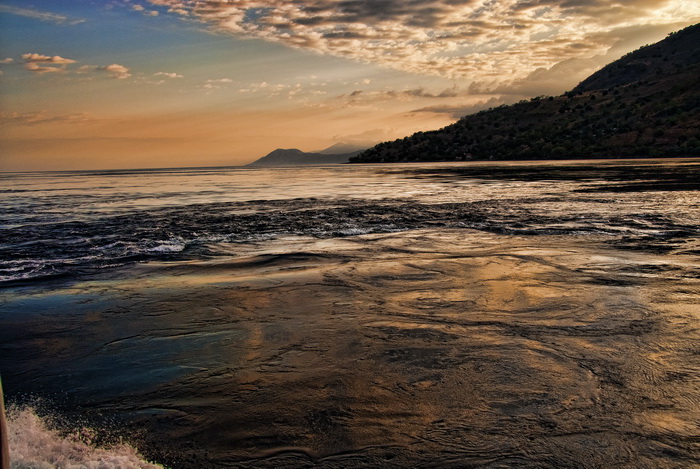
Of these the 35km wide Lombok Strait offers the most direct path to the Indian Ocean. And it is estimated that about 20% of the shallow water flow of the Indonesian Throughflow passes through that conduit. Which in terms of rivers means 3000 of them!
This helps to explain the intense biodiversity of some of Bali’s reefs and dive sites. But the other piece of the puzzle are the seasonal upwellings from the deep waters around the island.
The Indonesian archipelago’s underwater topography is incredibly complex with deep trenches, troughs and basins surrounding its 18,000 islands. Around the Lesser Sundas it is particularly complex and as the Indonesian Throughflow weaves its way over and through this underwater landscape it creates specific upwellings. These carry streams of nutrient rich cold water from the deep, which nourish the reefs of eastern Bali and other hot spots on the island.